
How Does Wind Form?
Start with sunlight warming the ground and see how temperature differences create pressure differences that set air in motion, giving rise to wind.
How Does Wind Form? Knowledge file
Wind is the horizontal flow of air: the Sun heats the surface, uneven heating creates pressure differences, air flows from high pressure to low, Earth's rotation bends it, and land-sea contrasts breed breezes and monsoons.
At a glance
- Nature of wind
- Horizontal air flow
- Energy source
- Solar radiation
- Deflection rule
- Right north, left south
- Monsoon scale
- Seasonal
Core concepts
Uneven heating is the source of wind
Land warms and cools faster than water, and the equator and poles are heated unevenly. Temperature differences create pressure differences, and air flowing from high to low pressure is wind.
Coriolis bends the wind
Earth's rotation deflects winds to the right in the Northern Hemisphere and to the left in the Southern Hemisphere. The stronger the wind and the higher the latitude, the greater the bend—large-scale winds never blow straight.
Sea breezes and monsoons share a cause
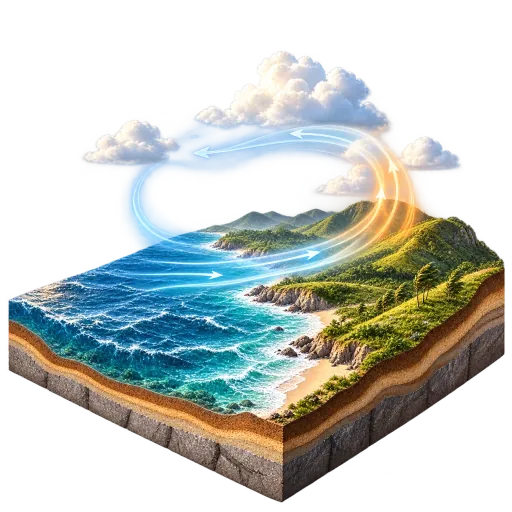
By day the sea breeze blows from ocean to land; at night the land breeze reverses. Scale the same land-sea contrast up to a season and you get the monsoon, which shapes life for billions.
Ways to understand
- Phase 1Heating and rising
Sunlight warms the land quickly; the warm air expands and rises, leaving low pressure at the surface.
- Phase 2Driven by pressure differences
High and low pressure face off, air flows from high to low, and that horizontal current is wind.
- Phase 3Deflection and circulation
The Coriolis effect bends the wind, and alternating land-sea heating drives sea breezes and monsoons.
What to observe
- ObserveWatch the airflow arrows
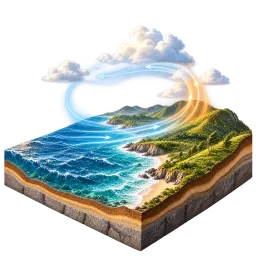
Air always flows from the cool high-pressure zone over the sea toward the warm low-pressure zone over land, reversing between day and night.
- ObserveNotice the paths curve
In stage 6 the airflow arrows gradually bend to one side—the cumulative effect of Coriolis deflection over long distances.
- ConsiderWhy the air is never perfectly still
As long as the surface heats unevenly, pressure differences exist and air must move. Wind is how Earth redistributes heat.