
Universe Voyager
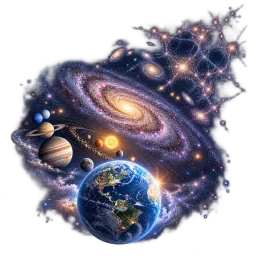
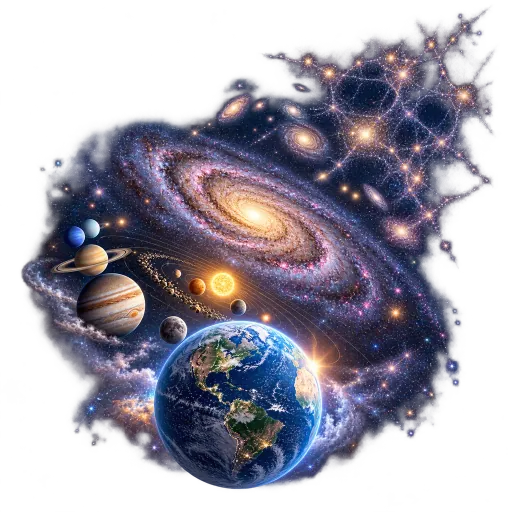
Zoom seamlessly from Earth through the Solar System, nearby stars, the Milky Way, and the Local Group to the edge of the observable universe.
Universe Voyager Knowledge file
Starting from Earth and pulling back without a break, the voyage places the Solar System, nearby stars, the Milky Way, the Local Group, and the observable universe into one continuous journey of scale.
At a glance
- Stops
- 6 scales
- Starting point
- Earth
- Destination
- The observable universe
- Final span
- About 93 billion light-years
Core concepts
One unbroken pull-back
Every stop nests into the previous one at its true position and scale, so six transitions read as a single continuous flight through space.
Space is mostly empty
From planetary orbits to interstellar gaps to the voids between galaxies, nearly all of the volume is close to vacuum.
The Sun is nothing special
The Sun is one ordinary star among hundreds of billions in the Milky Way, and the observable universe holds hundreds of billions of galaxies.
Ways to understand
- Stops 1–2Planetary and stellar systems
Light crosses the Earth–Moon gap in just over a second, while sunlight takes more than four hours to reach Neptune's orbit.
- Stops 3–4Stars gather into galaxies
Even the nearest stars lie light-years apart; gravity gathers hundreds of billions of them into a galaxy 100,000 light-years wide.
- Stops 5–6Galaxies weave the cosmic web
Galaxies cluster along filaments into groups and clusters, leaving vast voids between them, together filling the observable universe.
What to observe
- ObserveWatch the jumps in magnitude
Each stop is several orders of magnitude larger than the last; watch how the scale readout changes as you zoom.
- ObserveFind where we are
Every stop marks the previous one's position: Earth in its orbit, the Sun on the Orion Arm, the Milky Way in the Local Group.
- ConsiderObservable is not everything
93 billion light-years is the edge of what we can see, not the edge of the universe itself.