
Pluto
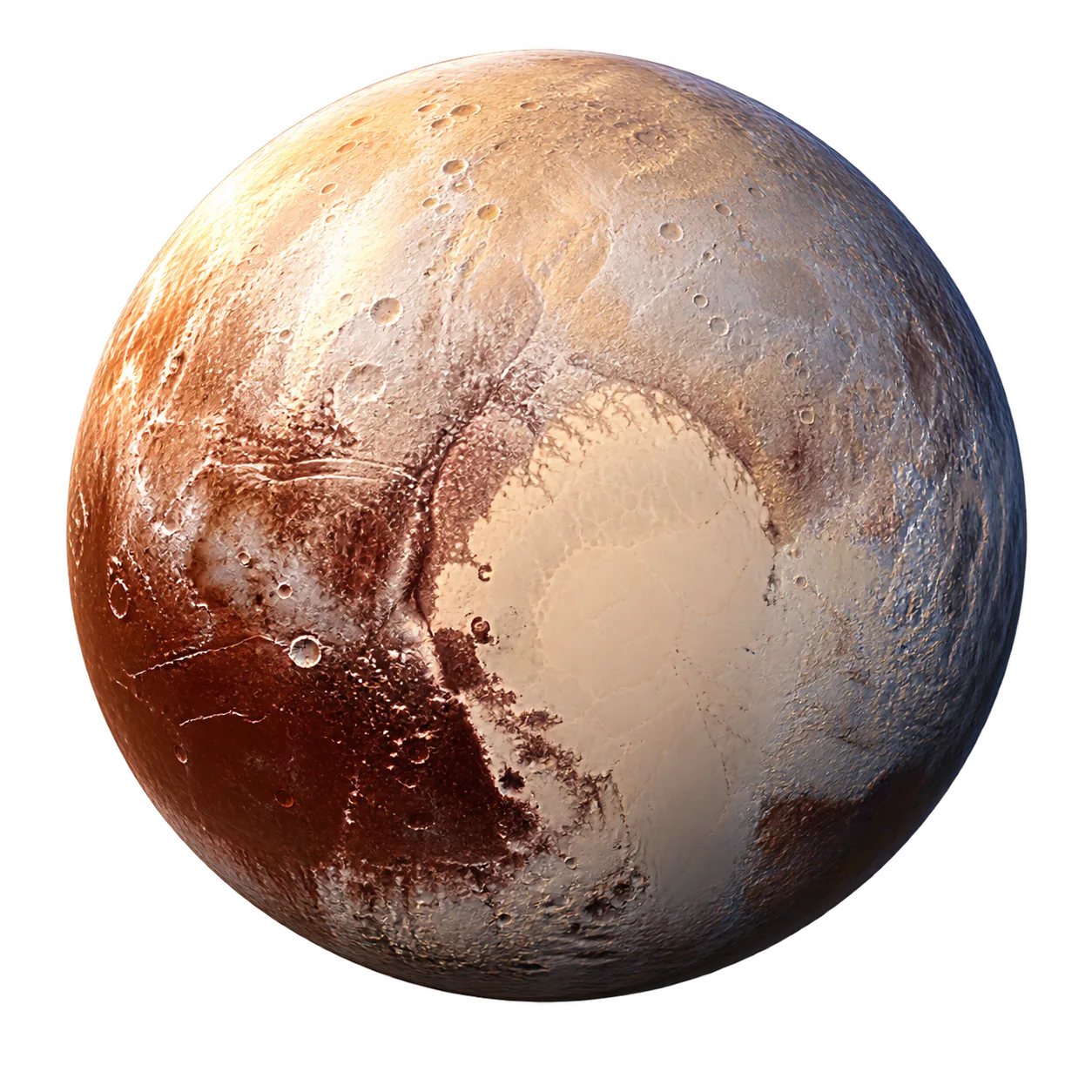
Pluto is the best-known dwarf planet in the Kuiper Belt. New Horizons revealed a far more active ice world than expected, with a bright heart-shaped region, nitrogen-ice plains, and towering mountains of water ice.
Pluto Science file
A heart-shaped ice plain, · in the Kuiper Belt
Basic properties
- Distance from the Sun
- 39.5 AU
- Equatorial diameter
- 2,377 km
- Orbital period
- 248 Earth years
- Rotation period
- 6.39 Earth days
- Surface gravity
- 6.3% of Earth's
- Typical temperature
- Average about −230°C
- Atmosphere
- Thin nitrogen with methane and carbon monoxide
- Moon system
- 5 · largest is Charon
Highlights
Sputnik Planitia
This bright nitrogen-ice plain forms the left half of Pluto's “heart” and has almost no visible impact craters.
Dancing with Charon
The pair's barycenter lies outside Pluto, so Pluto and its largest moon are often described as a near-binary dwarf-planet system.
A dwarf planet since 2006
Pluto orbits the Sun and is nearly round, but has not cleared its orbital neighborhood, placing it in the current dwarf-planet category.