
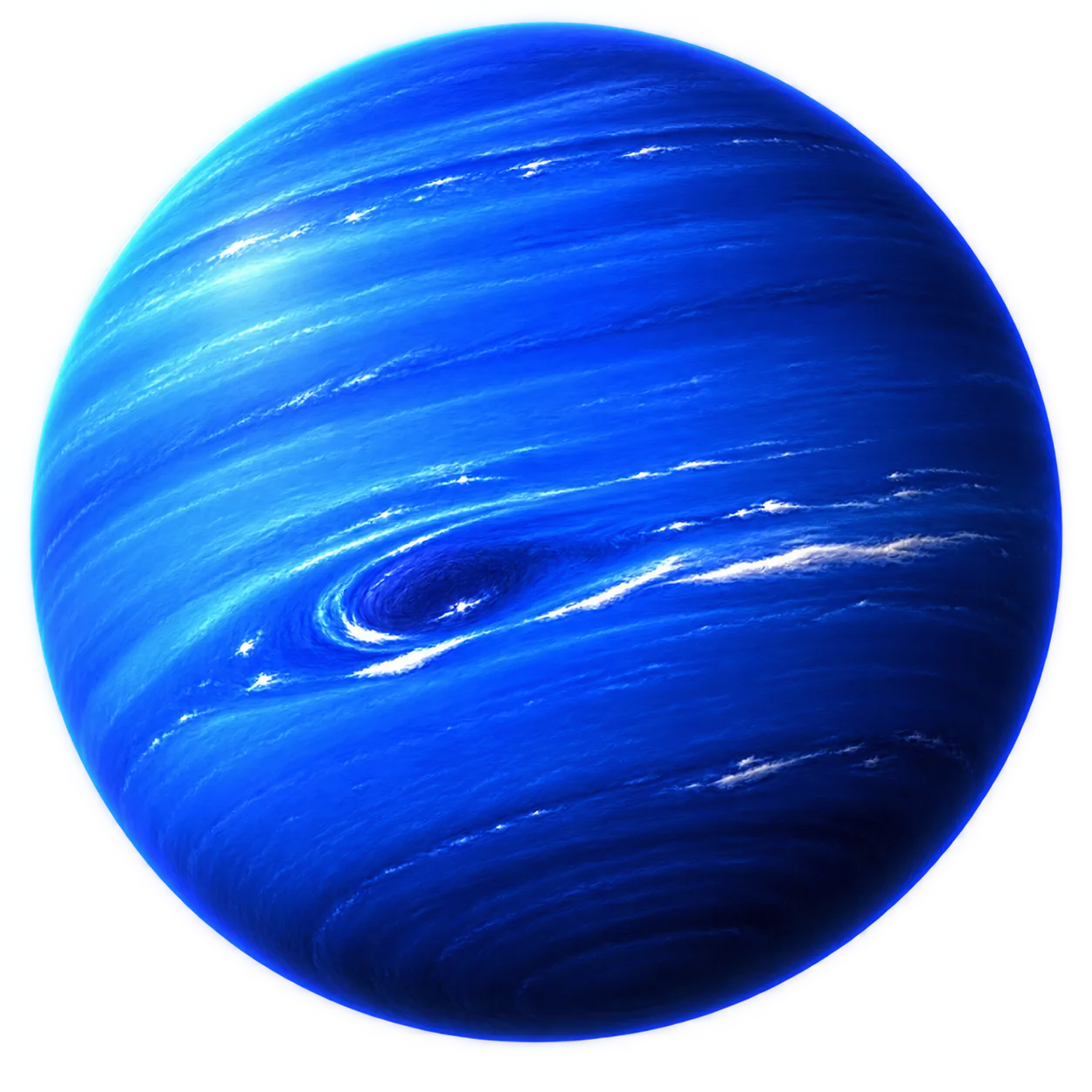
Neptune
Neptune is the planet farthest from the Sun. Sunlight takes about four hours to arrive, yet its atmosphere is anything but calm: heat escaping from within drives the fastest planetary winds in the Solar System.
Neptune Science file
Winds up to 2,100 km/h · Sunlight's one-way trip about 4.1 hours
Basic properties
- Distance from the Sun
- 30.1 AU
- Equatorial diameter
- 49,244 km
- Orbital period
- 164.8 Earth years
- Rotation period
- About 16.1 hours
- Surface gravity
- 1.14 times Earth's
- Typical temperature
- Cloud tops about −200°C
- Atmosphere
- Hydrogen, helium, and methane
- Moon system
- Triton and other icy moons
Highlights
Speeds above 2,000 km/h
High-altitude cloud bands and immense storms move at astonishing speeds; their energy source remains an active research topic.
First found on paper
Astronomers predicted its location from small deviations in Uranus's orbit, then confirmed it by observation in 1846.
A retrograde ice world
Triton orbits Neptune backward and was probably captured from the Kuiper Belt.
Orbital parameters
- Orbital eccentricity
- 0.0086
- Orbital inclination
- 1.77°
- Orbital period
- 164.8 years
- Diameter / Earth
- 3.88 × Earth
AU is the astronomical unit; 1 AU is approximately the mean distance from Earth to the Sun.
Selected exploration milestones
- Le Verrier and Galle
Predicted Neptune from orbital perturbations and found it within about 1°.
- Voyager 2
The only close visit to date, recording the Great Dark Spot and Triton.
- James Webb Space Telescope
Near-infrared images clearly revealed Neptune's rings and Triton.
Selected representative missions; this is not a complete mission list.