
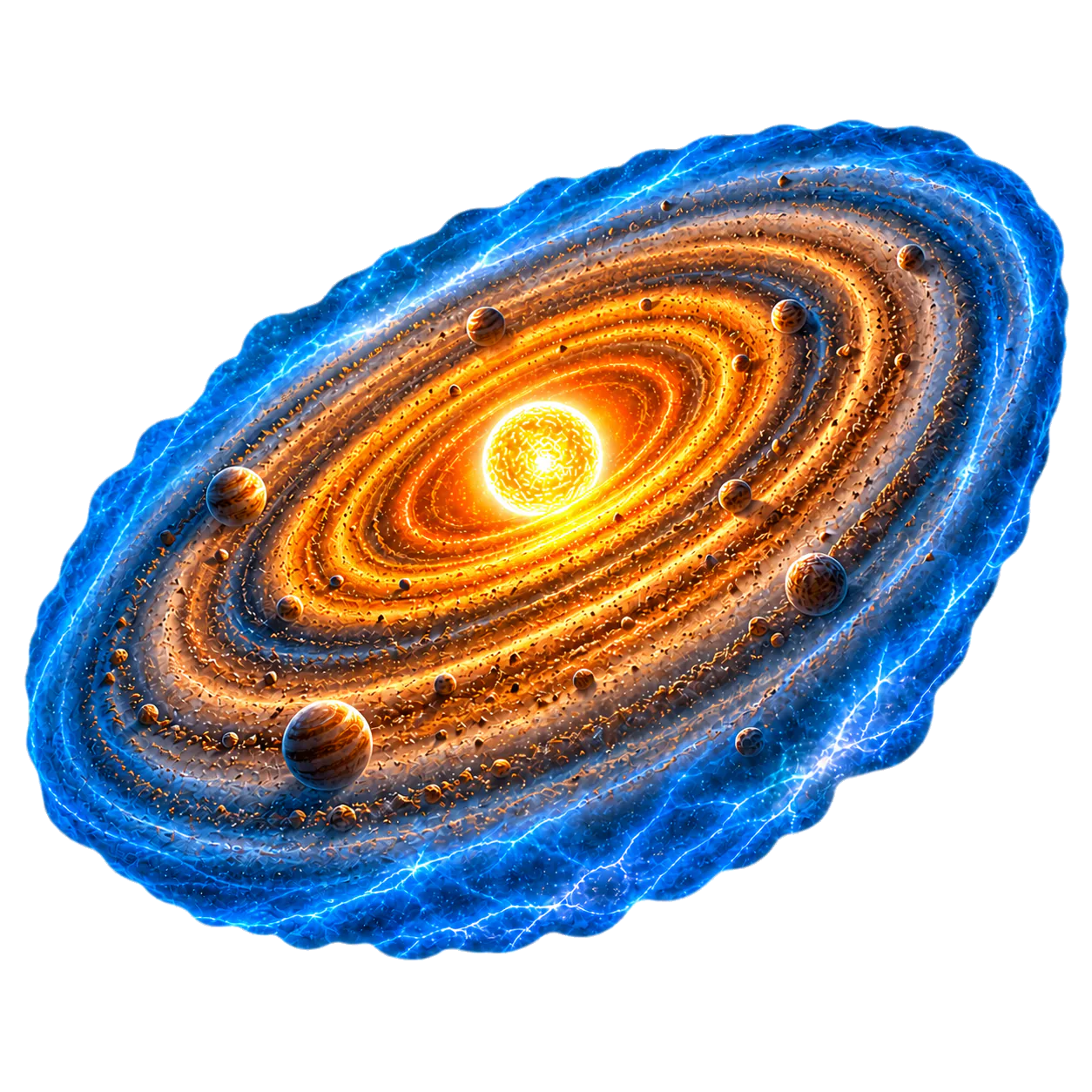
Birth of the Solar System Simulator
Thirteen animated 3D stages watch a cold molecular cloud collapse, spin into a disk, ignite the Sun, and grow into today's stable eight-planet system after great collisions.
Birth of the Solar System Simulator Knowledge file
About 4.6 billion years ago, a molecular cloud collapsed into a spinning disc. The Sun ignited at the center, while dust and ice gradually grew into planets.
At a glance
- Began
- About 4.6 billion years ago
- Stages
- 13
- Central process
- Gravitational collapse and accretion
- Final system
- The Sun and eight planets
Core concepts
Angular momentum flattens the cloud
As the cloud contracts it spins faster; collisions remove vertical motion and concentrate matter into a flat protoplanetary disc.
Temperature determines materials
Near the Sun only rock and metal can condense; beyond the snow line, water, ammonia, and methane ice let planetary cores grow faster.
Planet growth was not peaceful
Dust first stuck into planetesimals, then accretion and giant impacts formed planets; Earth's Moon may have come from one such collision.
Ways to understand
- Stage oneCloud collapse and solar ignition
Gravity drew matter toward the center, heating the core until hydrogen fusion began.
- Stage twoDust aggregation and planetary embryos
Particles grew through collisions, while larger bodies used gravity to accelerate accretion.
- Stage threeOrbit clearing and late bombardment
Migrating planets scattered leftover small bodies as the system approached its present stable form.
What to observe
- ObserveWatch the shape change
The cloud's change from a sphere into a thin disc through collapse and rotation explains why planetary orbits are nearly coplanar.
- ObserveCompare inner and outer materials
The temperature gradient explains the difference between inner rocky planets and outer giant planets.
- ConsiderThis is a model, not a recording
The real process lasted tens of millions of years; the interactive compresses time, scale, and complex collisions into visible stages.