
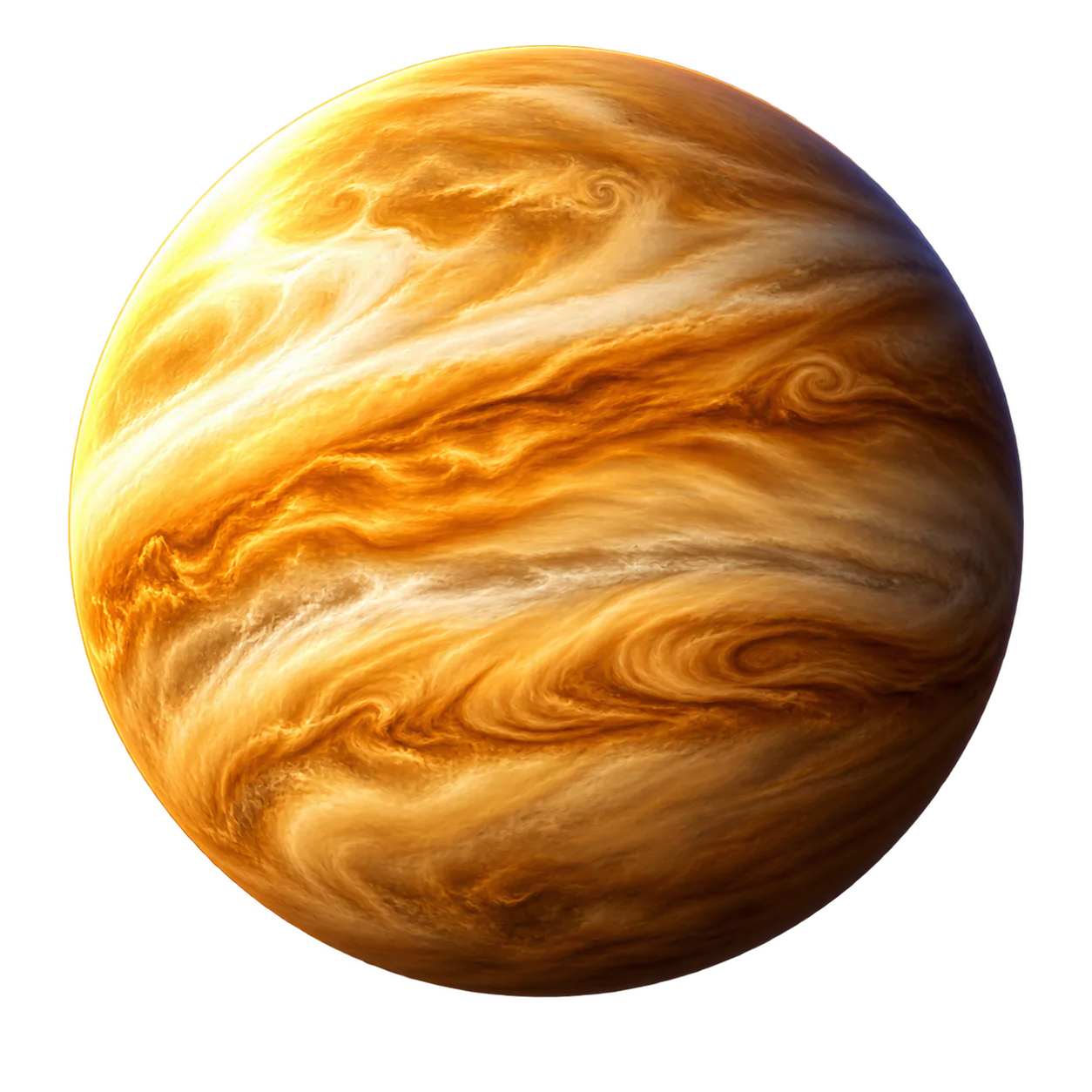
Venus
Venus is close to Earth in size but followed a radically different path. Its dense carbon-dioxide atmosphere and sulfuric-acid clouds trap heat so effectively that its surface is hotter than Mercury's.
Venus Science file
Surface 465°C · Pressure 92 bar · Sulfuric-acid clouds
Basic properties
- Distance from the Sun
- 0.72 AU
- Equatorial diameter
- 12,104 km
- Orbital period
- 224.7 Earth days
- Rotation period
- 243 Earth days
- Surface gravity
- 90% of Earth's
- Typical temperature
- Average about 465°C
- Atmosphere
- About 96.5% carbon dioxide
- Moon system
- No natural moons
Highlights
The Sun rises in the west
Venus rotates opposite to most planets, and one rotation takes longer than one orbit around the Sun.
Nearly 90 times Earth's sea-level pressure
The pressure at the surface resembles that roughly 900 meters beneath Earth's ocean.
A young, active surface
Radar observations reveal extensive volcanic terrain and strong evidence of geologically recent activity.
Orbital parameters
- Orbital eccentricity
- 0.0068
- Orbital inclination
- 3.39°
- Orbital period
- 224.7 days
- Diameter / Earth
- 0.95 × Earth
AU is the astronomical unit; 1 AU is approximately the mean distance from Earth to the Sun.
Selected exploration milestones
- Venera 7
The first probe to land successfully on another planet and transmit data.
- Venera 9
Returned the first photograph from the surface of another planet.
- Magellan
Mapped about 98% of Venus's hidden surface with radar.
Selected representative missions; this is not a complete mission list.