
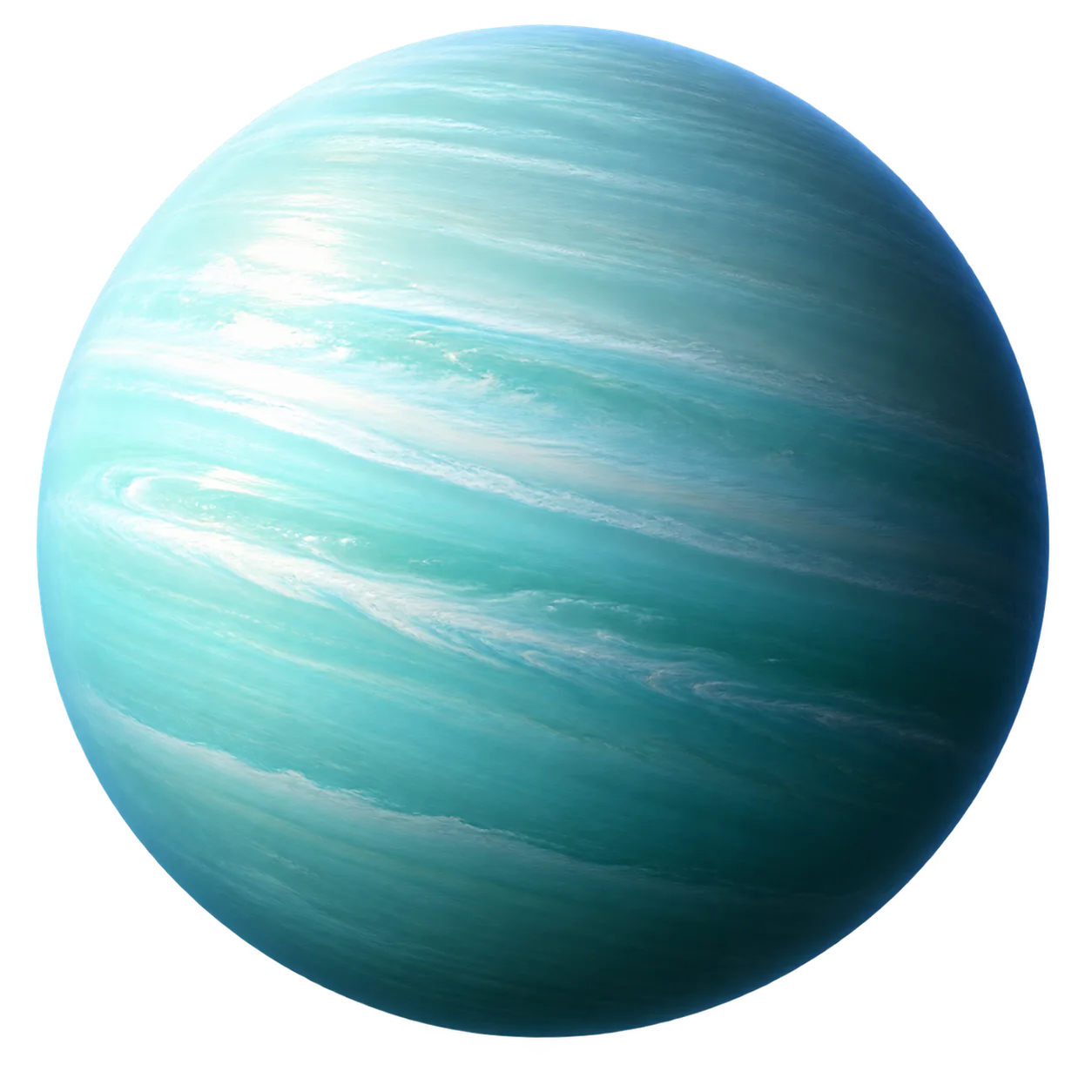
Uranus
Uranus's spin axis lies almost in its orbital plane, so it circles the Sun like a rolling ball. Methane absorbs red light, giving its cloud tops a muted blue-green color.
Uranus Science file
Axial tilt 97.8° · Lowest atmospheric temperature −224°C
Basic properties
- Distance from the Sun
- 19.2 AU
- Equatorial diameter
- 50,724 km
- Orbital period
- 84 Earth years
- Rotation period
- About 17.2 hours
- Surface gravity
- 89% of Earth's
- Typical temperature
- As low as about −224°C
- Atmosphere
- Hydrogen, helium, and methane
- Moon system
- Many icy moons
Highlights
An extreme 98° tilt
One or more giant impacts in the distant past may have produced Uranus's unusual orientation.
Each season lasts about 21 years
Its long orbit and extreme tilt make each pole alternate between decades of sunlight and darkness.
The Solar System's lowest planetary temperature
Although Neptune is farther away, the lowest atmospheric temperature measured on Uranus is colder.
Orbital parameters
- Orbital eccentricity
- 0.0472
- Orbital inclination
- 0.77°
- Orbital period
- 84.02 years
- Diameter / Earth
- 4.01 × Earth
AU is the astronomical unit; 1 AU is approximately the mean distance from Earth to the Sun.
Selected exploration milestones
- William Herschel
The first telescopic identification of the planet expanded the known Solar System.
- Voyager 2
The only spacecraft so far to visit Uranus at close range.
- James Webb Space Telescope
Near-infrared observations resolved delicate rings and polar features.
Selected representative missions; this is not a complete mission list.