
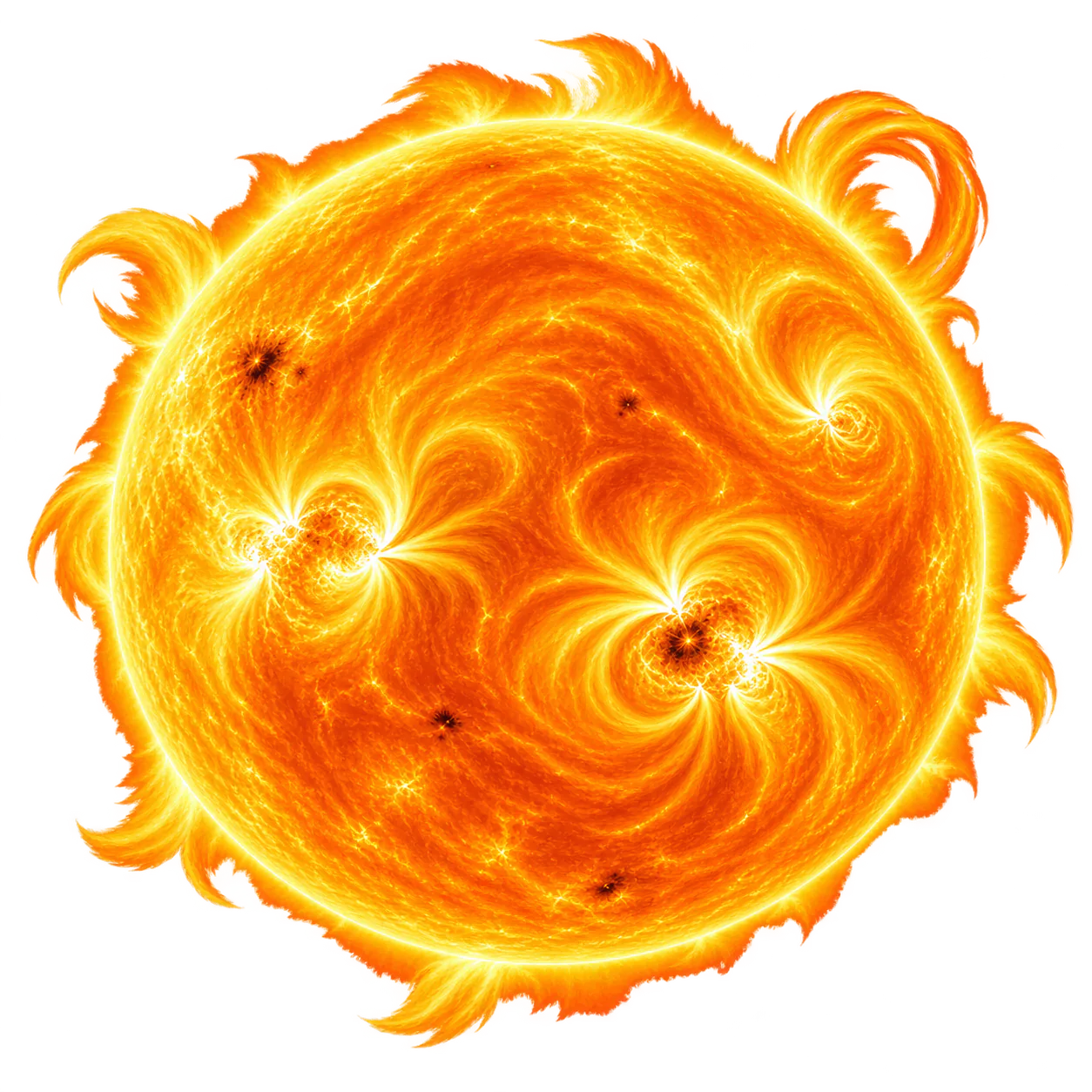
Sun
The Sun is the star at the center of the Solar System, a vast sphere of hot plasma. Hydrogen fusion in its core continuously releases the light and heat that sustain Earth's climate, while its gravity keeps the planets, small bodies, and dust in orbit.
Sun Science file
One star, · lighting the entire Solar System
Basic properties
- Solar System position
- Center of the Solar System
- Equatorial diameter
- 1,392,700 km
- Stellar age
- About 4.6 billion years
- Rotation period
- About 25.4 days at the equator
- Surface gravity
- About 28 times Earth's
- Photosphere temperature
- Photosphere about 5,500°C
- Main composition
- Hydrogen-helium plasma
- Orbiting bodies
- 8 planets and many small bodies
Highlights
The energy factory in the core
At about 15 million°C, hydrogen continuously fuses into helium, converting a small amount of mass into an immense flow of energy.
Sunlight reaches Earth in about 8 min 20 sec
Light leaves the Sun and crosses one astronomical unit at roughly 300,000 kilometers per second before reaching Earth.
About 99.86% of the Solar System's mass
The Sun's powerful gravity dominates the Solar System, keeping planets, comets, and countless small bodies in orbit.