
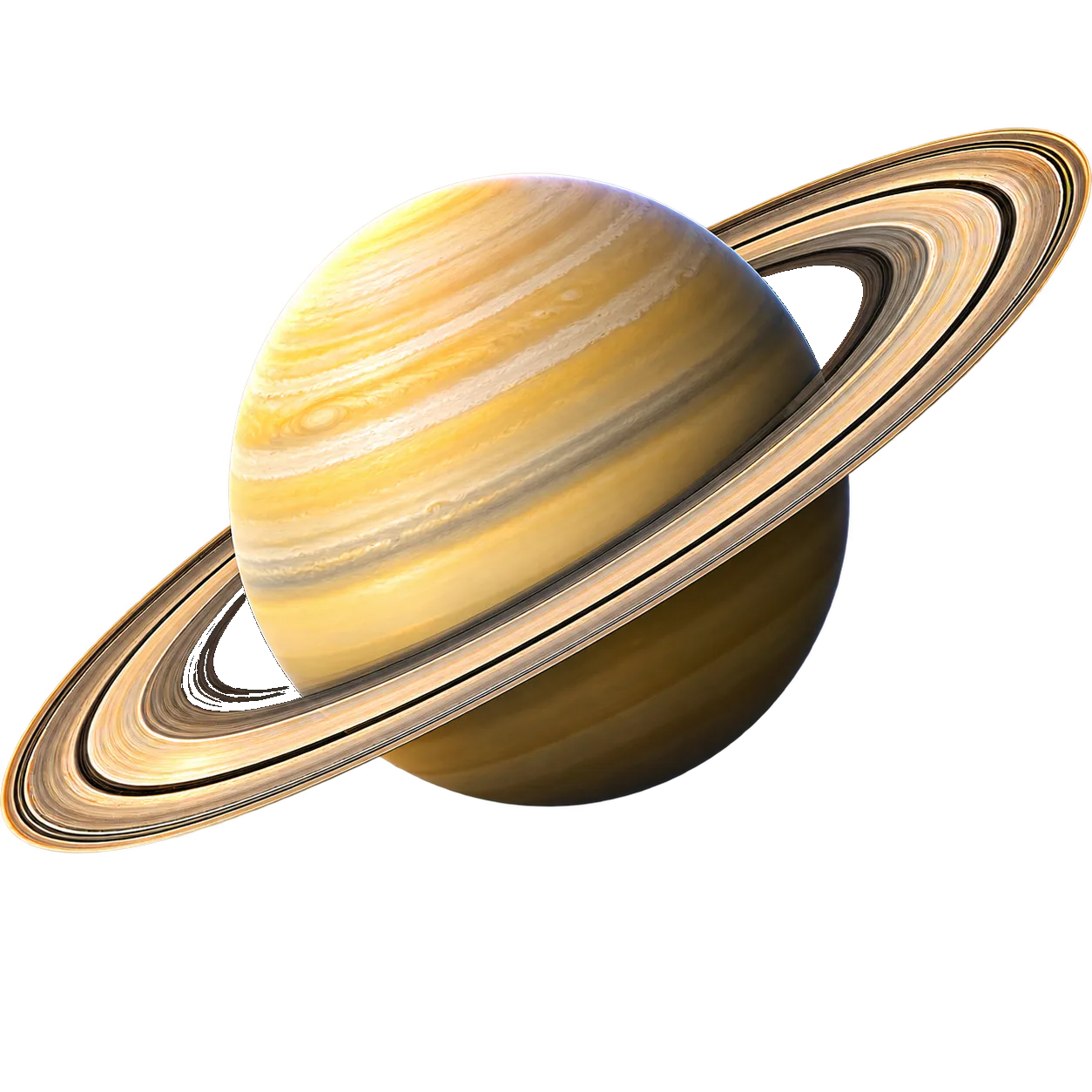
Saturn
Saturn is famous for its magnificent rings. The apparently continuous bands are actually countless pieces of ice and rock, ranging in size from dust grains to objects as large as houses.
Saturn Science file
Mean density 0.69 g/cm³ · A 282,000-km-wide ring system
Basic properties
- Distance from the Sun
- 9.58 AU
- Equatorial diameter
- 116,460 km
- Orbital period
- 29.45 Earth years
- Rotation period
- About 10.7 hours
- Surface gravity
- 1.07 times Earth's
- Typical temperature
- Cloud tops about −140°C
- Atmosphere
- Mostly hydrogen and helium
- Moon system
- A vast family of moons
Highlights
Broad yet extraordinarily thin
The main rings span hundreds of thousands of kilometers, but most are only tens of meters thick vertically.
Less dense than water on average
Saturn has the lowest mean density of any planet, though the comparison does not mean it could literally float in an ocean.
A moon with weather
Titan has a dense atmosphere and lakes and channels of liquid methane and ethane on its surface.
Orbital parameters
- Orbital eccentricity
- 0.0565
- Orbital inclination
- 2.49°
- Orbital period
- 29.45 years
- Diameter / Earth
- 9.45 × Earth
AU is the astronomical unit; 1 AU is approximately the mean distance from Earth to the Sun.
Selected exploration milestones
- Pioneer 11
The first Saturn flyby, paving the way for the Voyager missions.
- Cassini–Huygens
Orbited Saturn for 13 years; Huygens landed on Titan in 2005.
- Grand Finale
Cassini completed 22 passages between the planet and its main rings.
Selected representative missions; this is not a complete mission list.