
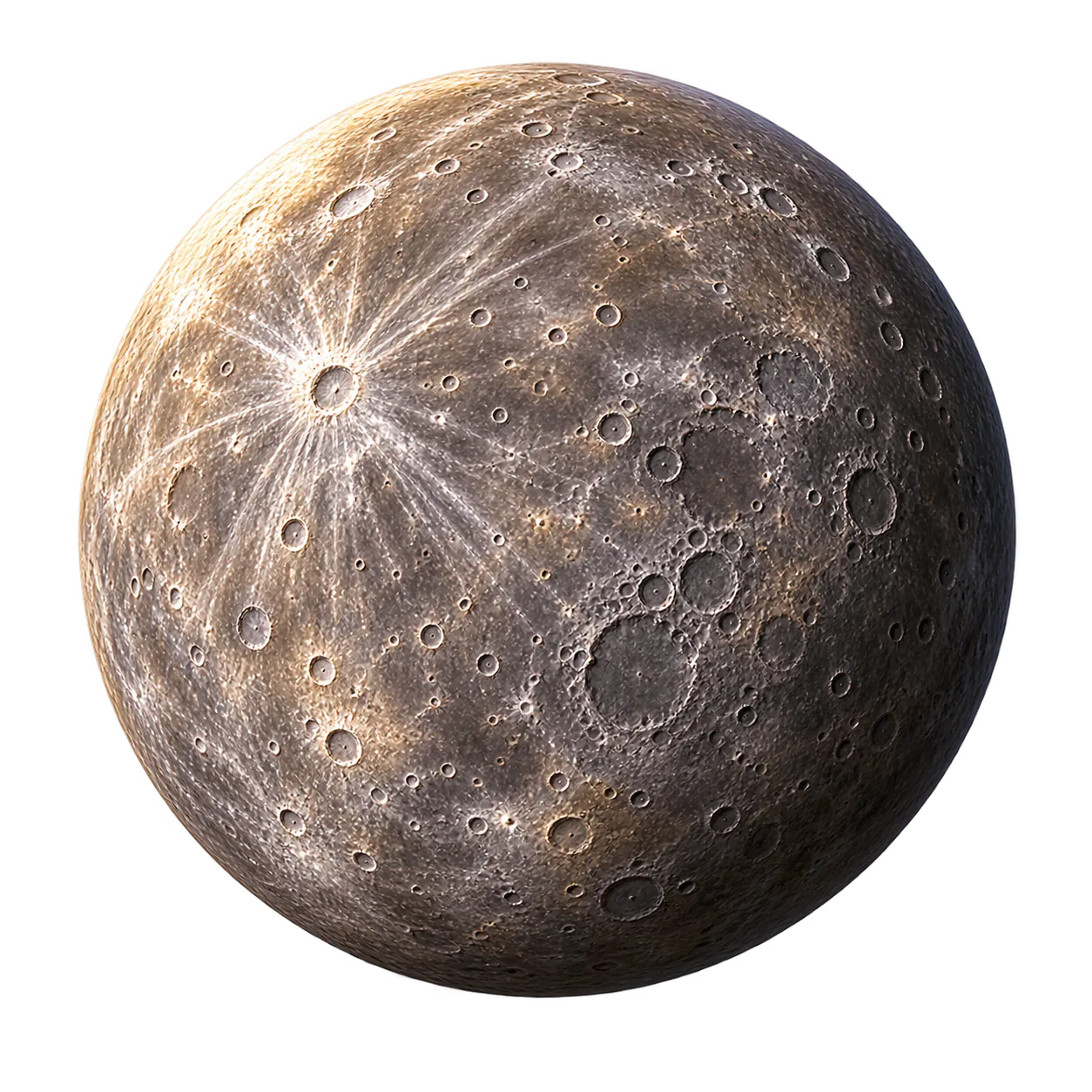
Mercury
Mercury is a cratered rocky world. It has almost no atmosphere to retain heat, so its sunlit side is scorching while the night side rapidly plunges into extreme cold.
Mercury Science file
Dayside 430°C · Nightside −180°C · 3:2 spin-orbit resonance
Basic properties
- Distance from the Sun
- 0.39 AU
- Equatorial diameter
- 4,879 km
- Orbital period
- 88 Earth days
- Rotation period
- 58.6 Earth days
- Surface gravity
- 38% of Earth's
- Typical temperature
- −180 to 430°C
- Atmosphere
- Extremely thin exosphere
- Moon system
- No natural moons
Highlights
A day spanning fire and ice
Its tenuous atmosphere cannot transport or store heat, so Mercury's day-night temperature range can exceed 600°C.
The fastest planet
Mercury travels around the Sun at an average of about 47 km/s and completes a year in only 88 Earth days.
The vast Caloris Basin
An ancient impact left a basin about 1,550 kilometers wide, one of the Solar System's largest impact structures.
Orbital parameters
- Orbital eccentricity
- 0.2056
- Orbital inclination
- 7.00°
- Orbital period
- 88.0 days
- Diameter / Earth
- 0.38 × Earth
AU is the astronomical unit; 1 AU is approximately the mean distance from Earth to the Sun.
Selected exploration milestones
- Mariner 10
Three flybys returned the first close-up images of Mercury.
- MESSENGER
The first Mercury orbiter mapped the globe over roughly 4,100 orbits.
- BepiColombo
A joint ESA/JAXA mission scheduled to arrive at Mercury in 2026.
Selected representative missions; this is not a complete mission list.