
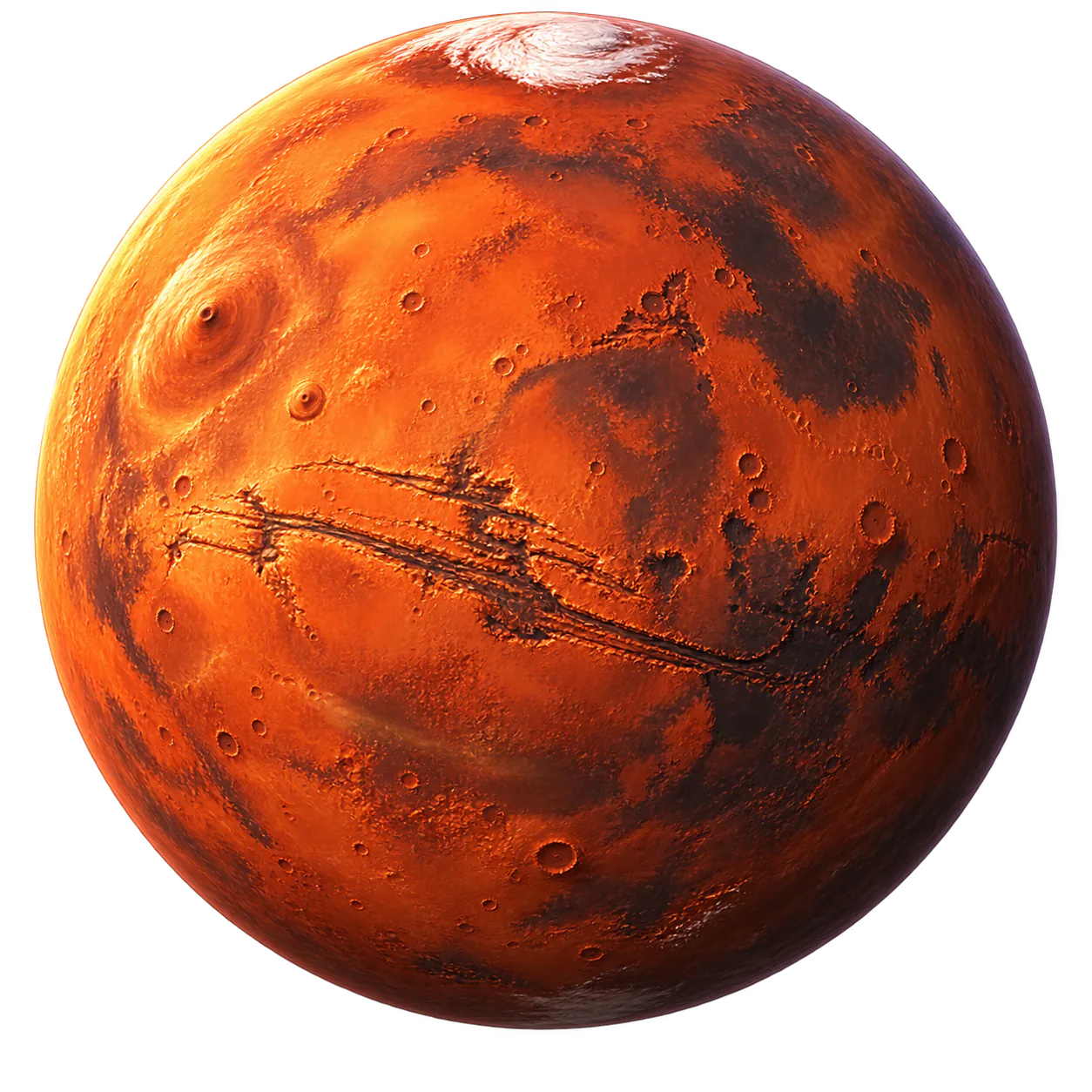
Mars
Iron oxide gives Mars its red color. Today it is cold and dry with a thin atmosphere, but channels, deltas, and hydrated minerals show that liquid water once flowed across ancient Mars.
Mars Science file
Average −63°C · 6 mbar CO₂ atmosphere · 2 moons
Basic properties
- Distance from the Sun
- 1.52 AU
- Equatorial diameter
- 6,779 km
- Orbital period
- 687 Earth days
- Rotation period
- 24 hr 37 min
- Surface gravity
- 38% of Earth's
- Typical temperature
- Average about −63°C
- Atmosphere
- About 95% carbon dioxide
- Moon system
- 2 · Phobos and Deimos
Highlights
Olympus Mons
This enormous shield volcano rises about 22 kilometers, making it the tallest known planetary mountain in the Solar System.
Valles Marineris
The canyon system stretches about 4,000 kilometers, nearly the width of the continental United States.
A world inhabited by robots
Orbiters, landers, and rovers continue to search for evidence of ancient habitable environments.
Orbital parameters
- Orbital eccentricity
- 0.0934
- Orbital inclination
- 1.85°
- Orbital period
- 687.0 days
- Diameter / Earth
- 0.53 × Earth
AU is the astronomical unit; 1 AU is approximately the mean distance from Earth to the Sun.
Selected exploration milestones
- Mariner 4
The first flyby returned 21 images of a cratered surface.
- Viking 1
One of the first landers to conduct a successful long-duration Mars surface mission.
- Curiosity
A nuclear-powered rover investigating ancient habitable environments in Gale Crater.
Selected representative missions; this is not a complete mission list.