
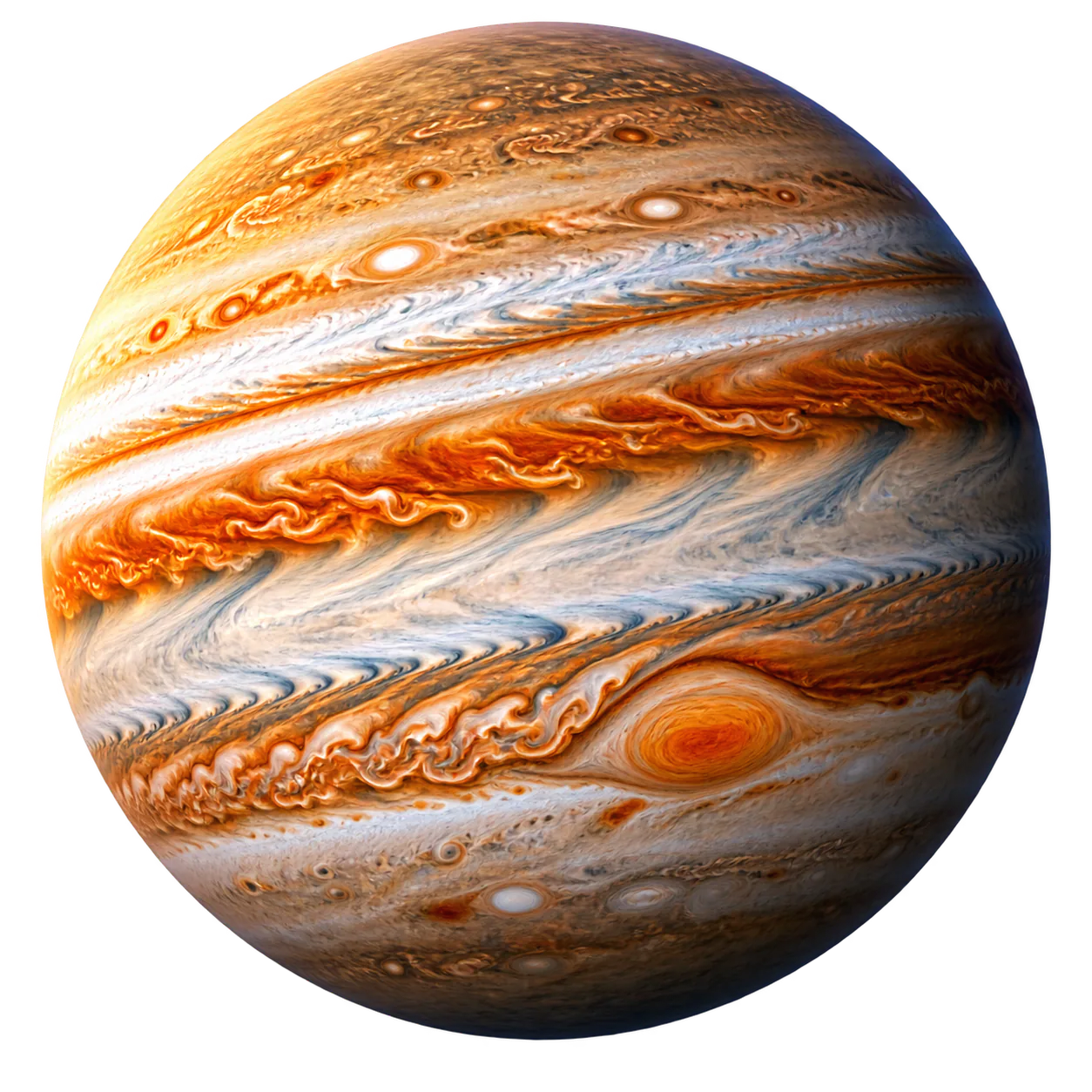
Jupiter
Jupiter is the Solar System's largest planet and is made mainly of hydrogen and helium. It has no solid surface to stand on; pressure rises inward as gas gradually changes into exotic fluid states.
Jupiter Science file
2.5 times the mass of all other planets combined · 9.9-hour rotation
Basic properties
- Distance from the Sun
- 5.20 AU
- Equatorial diameter
- 139,820 km
- Orbital period
- 11.86 Earth years
- Rotation period
- 9 hr 56 min
- Surface gravity
- 2.53 times Earth's
- Typical temperature
- Cloud tops about −110°C
- Atmosphere
- Mostly hydrogen and helium
- Moon system
- A vast family of moons
Highlights
The Great Red Spot
This anticyclonic storm, wider than Earth, has persisted for at least centuries, although it is slowly shrinking.
The shortest day in the Solar System
Jupiter rotates in under ten hours; its rapid spin produces a pronounced equatorial bulge.
Four Galilean worlds
Io, Europa, Ganymede, and Callisto reveal volcanic terrain, hidden oceans, and ancient cratered surfaces.
Orbital parameters
- Orbital eccentricity
- 0.0489
- Orbital inclination
- 1.31°
- Orbital period
- 11.86 years
- Diameter / Earth
- 11.21 × Earth
AU is the astronomical unit; 1 AU is approximately the mean distance from Earth to the Sun.
Selected exploration milestones
- Pioneer 10
The first Jupiter flyby and first passage through its intense radiation belts.
- Galileo
The first Jupiter orbiter, carrying a probe into the atmosphere.
- Juno
Measures Jupiter's interior, gravity field, and auroras from a polar orbit.
Selected representative missions; this is not a complete mission list.