
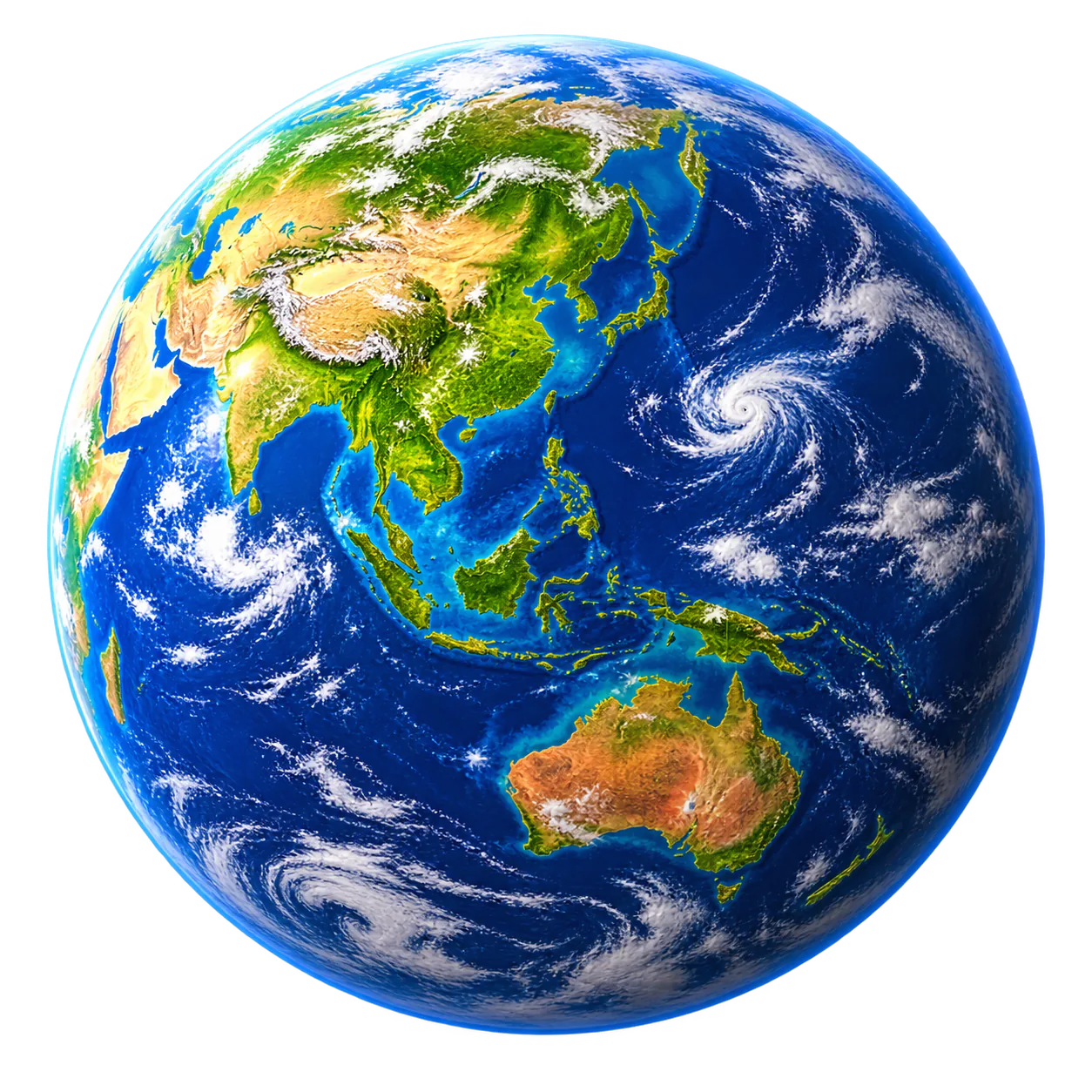
Earth
Earth is the only world currently known to harbor life. Liquid water covers most of its surface, while the atmosphere, magnetic field, and active geological cycles maintain conditions in which life can evolve.
Earth Science file
71% ocean · 1 Moon · The only known world with life
Basic properties
- Distance from the Sun
- 1.00 AU
- Equatorial diameter
- 12,742 km
- Orbital period
- 365.25 days
- Rotation period
- 23 hr 56 min
- Surface gravity
- 9.81 m/s²
- Typical temperature
- Global average about 15°C
- Atmosphere
- About 78% nitrogen, 21% oxygen
- Moon system
- 1 · the Moon
Highlights
Water covers 71% of the surface
The oceans regulate climate, participate in the carbon cycle, and provide vast, stable habitats for life.
An invisible shield
Motion in the liquid outer core generates a global magnetic field that deflects many energetic charged particles in the solar wind.
A surface that renews itself
Plate tectonics continually reshapes continents and oceans and helps regulate global climate over immense timescales.
Orbital parameters
- Orbital eccentricity
- 0.0167
- Orbital inclination
- 0.00°
- Orbital period
- 365.25 days
- Diameter / Earth
- 1.00 × Earth
AU is the astronomical unit; 1 AU is approximately the mean distance from Earth to the Sun.
Selected exploration milestones
- Sputnik 1
The first artificial Earth satellite, completing each orbit in about 96 minutes.
- Vostok 1
Yuri Gagarin completed the first crewed orbital flight around Earth.
- Apollo 8
Humans photographed “Earthrise” from lunar orbit for the first time.
Selected representative missions; this is not a complete mission list.