
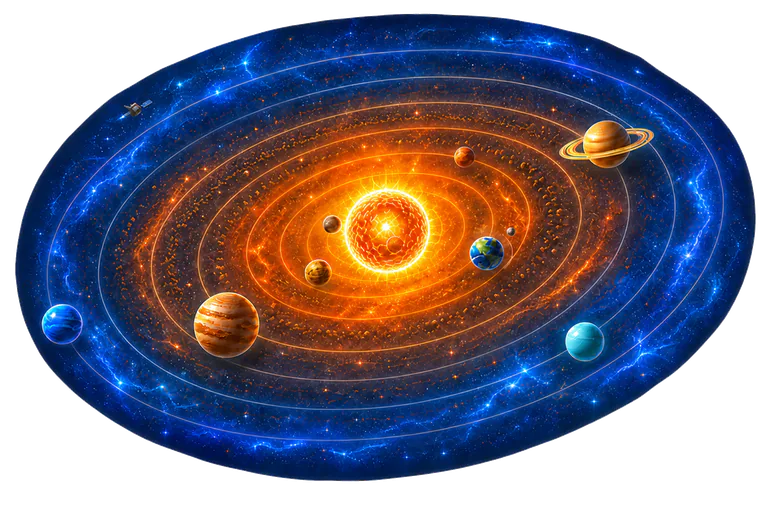
3D Solar System
Explore the Sun, planets, natural satellites, and dwarf planets moving through an interactive 3D orbital space.
3D Solar System Knowledge file
One star, eight planets, and countless moons, asteroids, and comets make up our planetary home.
At a glance
- Formed
- About 4.6 billion years ago
- Central body
- The Sun
- Planets
- 8
- Outer boundary
- As far as the Oort Cloud
Core concepts
The Sun anchors the system
The Sun contains about 99.8% of the Solar System's mass. Its gravity keeps planets and countless smaller bodies in orbit.
Rocky inside, giant outside
Four rocky planets lie close to the Sun; beyond the asteroid belt are two gas giants and two ice giants.
Empty space is the norm
The bodies themselves occupy very little space. At true scale, the gaps between planets are far larger than most diagrams suggest.
Ways to understand
- RegionInner Solar System
Mercury through Mars are dominated by rock and metal, with smaller sizes and higher densities.
- RegionOuter Solar System
Beyond Jupiter, giant planets dominate and support complex systems of moons and rings.
- FrontierBeyond Neptune
The Kuiper Belt, scattered disc, and distant Oort Cloud preserve icy material from the early Solar System.
What to observe
- ObserveCompare orbital speeds
Bodies closer to the Sun generally move faster and complete an orbit in less time.
- ObserveNotice the orbital plane
The eight planets orbit in roughly the same plane and direction, preserving the imprint of the protoplanetary disc.
- ConsiderSeparate size from distance
Interactive scenes compress sizes or distances so that bodies and orbits can be seen together.