
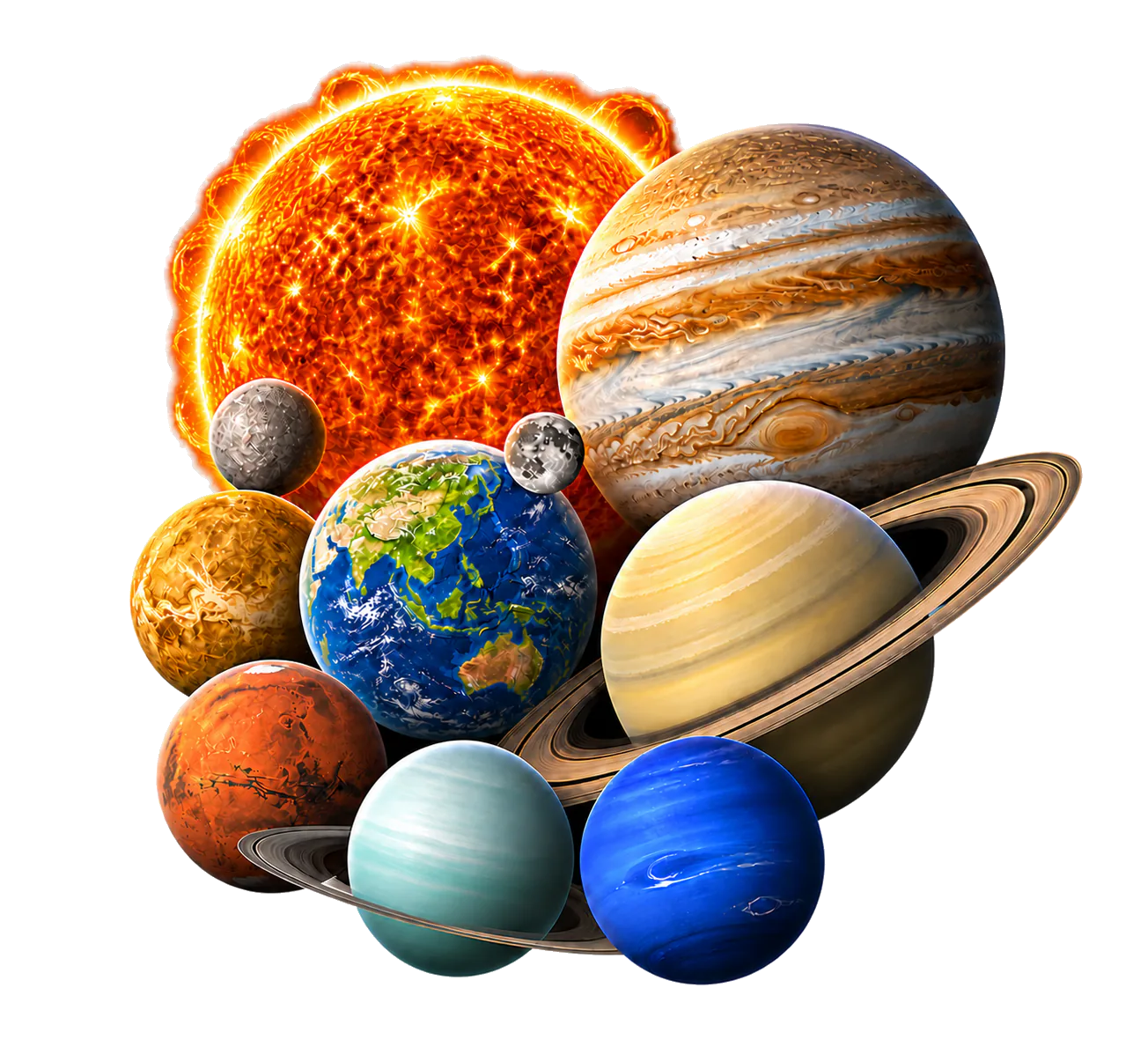
Sizes in the Solar System
Compare ten representative Solar System bodies by diameter, from the Moon to the Sun.
Sizes in the Solar System Knowledge file
Using diameter as a common ruler, compare representative Solar System bodies from the Moon to the Sun.
At a glance
- Moon diameter
- 3,474 km
- Earth diameter
- 12,742 km
- Jupiter diameter
- About 140,000 km
- Sun diameter
- About 1.39 million km
Core concepts
Diameter is only one dimension
If diameter grows tenfold, volume grows about a thousandfold. Small-looking diameter differences can mean huge differences in capacity.
Jupiter could hold many Earths
Jupiter is about 11 Earth diameters wide but has roughly 1,300 times Earth's volume.
The Sun dominates the scale
The Sun is about 109 Earth diameters wide and has room for roughly 1.3 million Earths by volume.
Ways to understand
- RockyTerrestrial bodies
The Moon, Mercury, Mars, Venus, and Earth have solid surfaces and are relatively small.
- GiantsGas and ice giants
Neptune, Uranus, Saturn, and Jupiter jump sharply in diameter, but their interiors are not solid spheres.
- StarThe Sun
As a star, the Sun greatly exceeds every planet in both mass and volume.
What to observe
- ObserveCompare diameter first
Treat Earth as 1 and compare how much screen width each body spans without being distracted by texture.
- ObserveThen imagine volume
Cube the diameter ratio to understand approximately how many smaller bodies could fit inside.
- ClarifySize is not mass
Saturn has enormous volume but low average density; size and mass do not increase in the same proportion.