
How Does Rain Form?
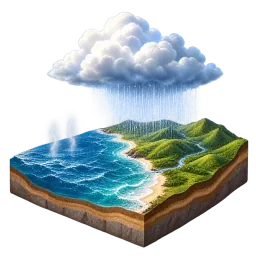
Follow water as it rises from the ocean into the sky, condenses into clouds, falls as rain, and flows through rivers back to the sea.
How Does Rain Form? Knowledge file
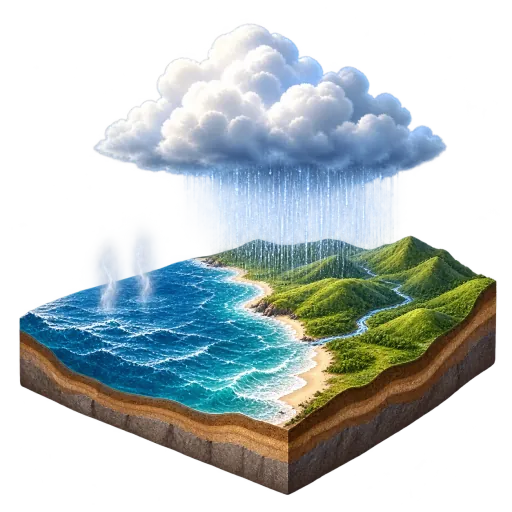
Rain comes from an unbroken cycle: the Sun heats the ocean, moisture rises and condenses into clouds, falls back as rain, and returns to the sea along rivers.
At a glance
- Cycle engine
- Solar radiation
- Raindrop diameter
- About 1–2 mm
- Cloud droplet diameter
- About 10–20 µm
- Main source
- Ocean evaporation
Core concepts
Droplets need condensation nuclei
Pure water vapor struggles to condense on its own. Dust, salt, and smoke particles act as nuclei onto which water molecules gather and grow into droplets.
Raindrops are built by collisions
A cloud droplet is a fraction of a hair's width; it must collide and merge until it is millions of times more massive before it can fall as rain.
Rain moves solar energy around
Evaporation carries heat away from the surface, and condensation releases it high in the atmosphere. The water cycle is also Earth's energy cycle.
Ways to understand
- Phase 1Evaporation and transport
The Sun heats the sea surface; moisture rises with warm, humid air and is carried downwind.
- Phase 2Condensation and growth
Cooling aloft condenses vapor into droplets, which collide and merge as the cloud thickens and darkens.
- Phase 3Rainfall and runoff
Droplets too heavy for the updraft fall as rain, follow the terrain into rivers, and return to the ocean.
What to observe
- ObserveWatch the cloud's color change
A cloud does not turn gray because it gets dirty; as droplets grow and crowd together, less and less sunlight reaches the cloud base.
- ObserveTrack water's three states
The same water switches between liquid, vapor, and cloud droplets; temperature differences drive the cycle.
- ConsiderWhy rain never falls from a blue sky
Only sufficiently thick clouds produce rain; small droplets re-evaporate mid-fall, forming invisible veils below the cloud.