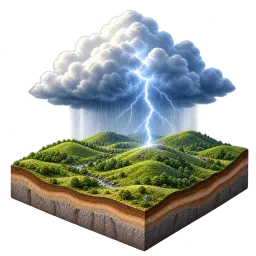

How Does Lightning Form?
Step inside a cumulonimbus cloud and see how electric charges build up and discharge, creating lightning that streaks across the sky.
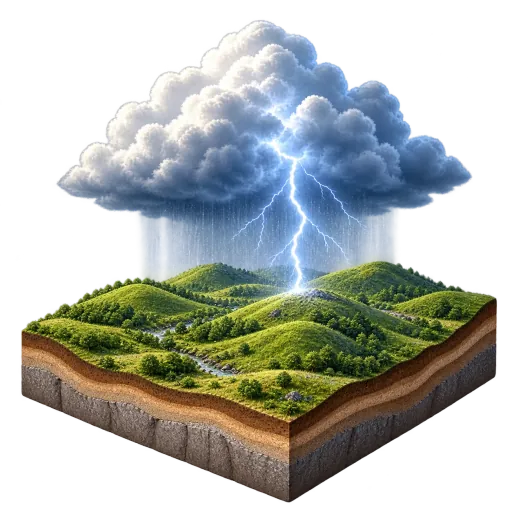
How Does Lightning Form? Knowledge file
Lightning is a violent discharge that follows charge separation inside a cumulonimbus cloud: colliding ice particles shuffle charge, a stepped leader carves an ionized channel, and the return stroke lights up the whole bolt in a fraction of a millisecond.
At a glance
- Return-stroke temperature
- About 30,000 °C
- Channel diameter
- Only a few centimetres
- Channel length
- Up to several kilometres
- Global frequency
- Dozens of flashes per second
Core concepts
Collisions electrify the cloud
Ice crystals, graupel, and supercooled droplets collide inside the storm. Lighter crystals carry positive charge up to the cloud top while heavier graupel sinks with negative charge, turning the cloud into a giant battery.
The return stroke out-heats the Sun
When the stepped leader meets the ground, current surges back up the channel and heats the air to about 30,000 °C—roughly five times the Sun's surface temperature. The channel is only centimetres wide yet can run for kilometres.
Flash first, thunder later
Light travels about 300,000 kilometres per second while sound covers only about 340 metres. Counting the seconds between the flash and the thunder even estimates the storm's distance.
Ways to understand
- Phase 1Cloud building and charging
Rising warm, moist air stacks up a vast cumulonimbus, and colliding ice particles gradually separate charge inside it.
- Phase 2Leader and return stroke
Negative charge at the cloud base descends as a stepped leader; once it connects, the return stroke lights up the whole channel.
- Phase 3Thunder and rain
Superheated air expands into a shock wave—thunder rolls in as heavy rain begins to fall.
What to observe
- ObserveWatch how the leader finds its path
The leader does not strike straight down; it advances in jumps, probing for the easiest route, which is why lightning always looks jagged and forked.
- ConsiderNot all lightning reaches the ground
Discharges within and between clouds far outnumber cloud-to-ground strikes; the bolts we see touching Earth are only a fraction of all lightning.
- SafetyAvoid high ground and lone trees in a storm
Lightning tends to strike tall, isolated objects. During a thunderstorm, stay away from open high ground, never shelter under a tree, and get inside a building or a closed vehicle.