
From Early Mammals to Humans
Trace 24 key milestones across more than 200 million years of mammal, primate, ape, and human evolution.
From Early Mammals to Humans Knowledge file
From early mammaliaforms, primates, and apes to hominins, modern humans are the surviving branch of a repeatedly splitting evolutionary tree.
At a glance
- Story begins
- About 200 million years ago
- Hominin split
- About 6–7 million years ago
- Homo sapiens appears
- About 300,000 years ago
- Exhibit milestones
- 24
Core concepts
Evolution is not a straight ladder
Different species coexisted, branched, and sometimes exchanged genes; one species did not simply turn into the next.
Bipedalism came before brain expansion
Hominin pelvises, spines, and feet adapted to two-legged walking before brain size increased dramatically.
Humans and apes share ancestors
Modern humans did not evolve from today's chimpanzees; the two share an earlier common ancestor.
Ways to understand
- MammaliaformsSmall ancestors and nocturnal adaptations
Early mammal lineages already existed in the age of dinosaurs and developed keen senses and warm-blooded physiology.
- PrimatesTree living, grasping, and depth vision
Flexible hands and feet plus forward-facing eyes helped early primates judge distances among branches.
- HomininsTwo legs, tools, and culture
Anatomy, technology, and social learning influenced one another and eventually shaped modern humans.
What to observe
- ObserveFollow branches, not rankings
Notice relationships and overlapping time ranges instead of treating species as higher or lower levels.
- ObserveCompare key bones
The foramen magnum, pelvis, femur, foot arch, and teeth provide important evidence for walking and diet.
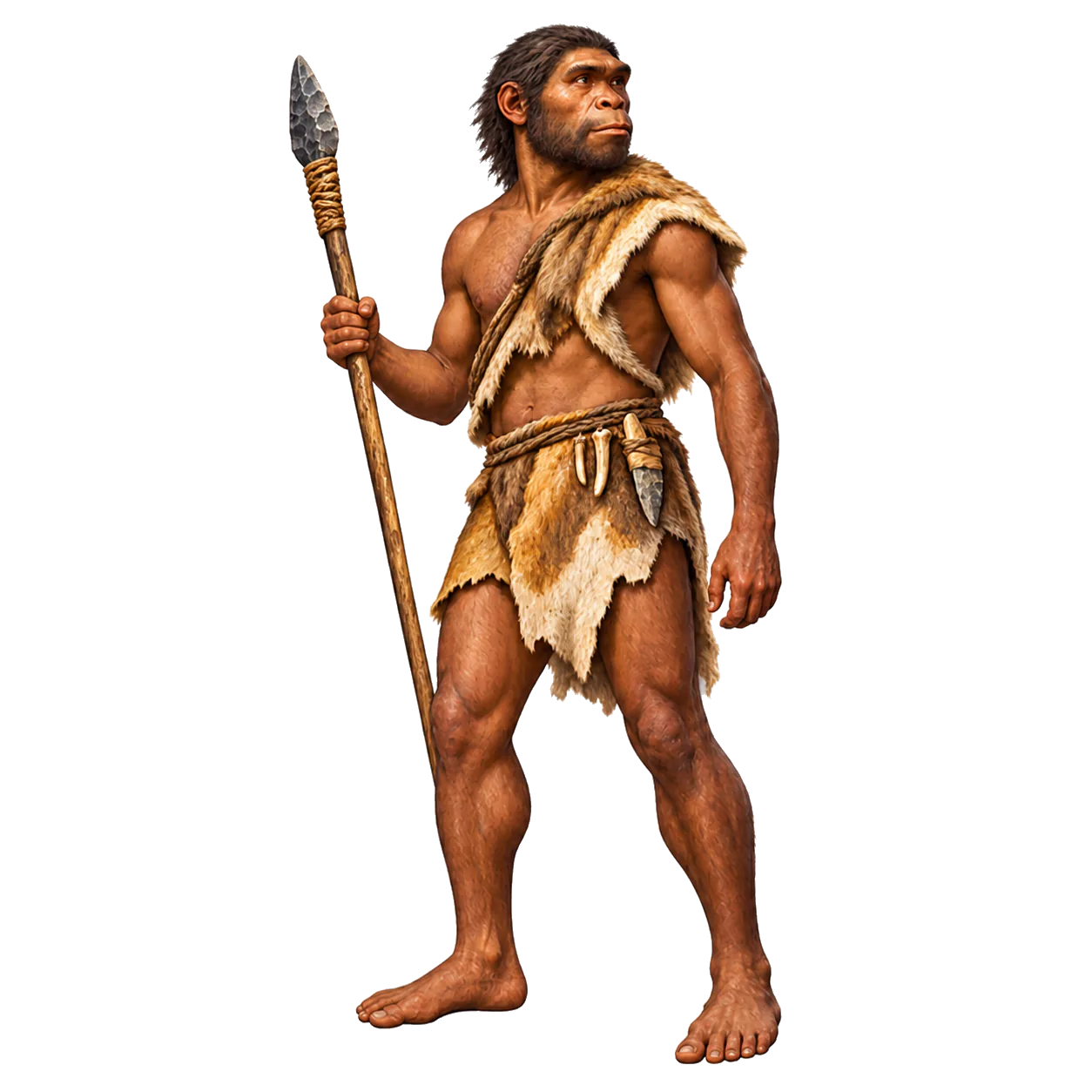
- ClarifyReconstructions contain uncertainty
Soft tissue, hair, and skin color rarely fossilize directly, so scientific reconstructions change as evidence improves.