
How Do Black Holes Form?
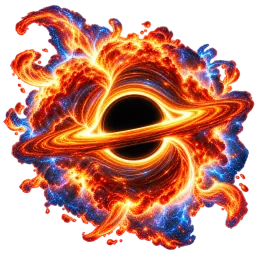
Six 3D stages follow a massive star as it runs out of fuel, collapses, explodes as a supernova, and falls inside its Schwarzschild radius to become a black hole.
How Do Black Holes Form? Knowledge file
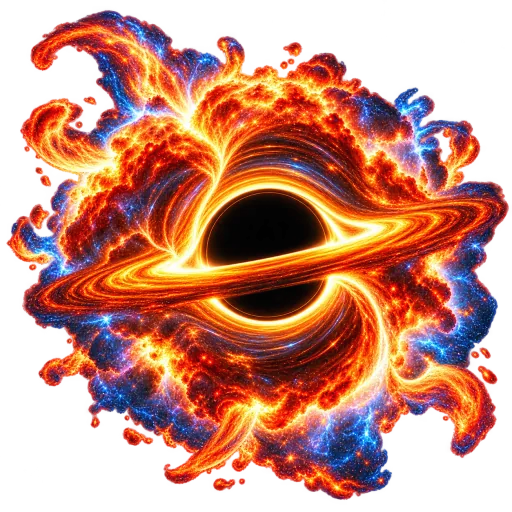
The death of a massive star is not an ending: its core collapses, a supernova erupts, and once the remnant falls inside its Schwarzschild radius, a black hole is born.
At a glance
- Progenitor star
- More than ~20 solar masses
- Iron-core collapse
- Under 1 second
- Horizon scale
- r = 2GM/c²
- Supernova brightness
- Can rival a whole galaxy
Core concepts
Fusion in onion shells
Hydrogen, helium, carbon, oxygen and silicon burn in successive stages, layering the ageing star like an onion; iron can no longer release energy through fusion.
Free fall in under a second
Unsupported, the iron core free-falls under gravity from thousands of kilometres to a few tens of kilometres, then rebounds and triggers a supernova.
A boundary light cannot cross
Once the remnant shrinks inside its Schwarzschild radius, no signal can escape — the event horizon has formed.
Ways to understand
- TimeMillions of years vs under a second
The star burns steadily for millions of years, yet its core collapses in less than a second — evolution accelerates violently at the end.
- EnergyNeutrinos carry almost everything
About 99% of a core-collapse supernova's energy escapes as neutrinos; visible light is only a small fraction.
- PathwaysBlack holes have more than one origin
Beyond stellar collapse, direct collapse, neutron-star mergers and primordial black holes from the early universe are also possible formation paths.
What to observe
- ObserveWatch the shells ignite inward
In the fuel chapter the fusion layers light up from the outside in, until only the iron core's ember remains.
- ObserveFeel the rhythm of collapse and blast
A rapid inward fall, a radial explosion, then a final contraction among the embers — the black hole is born in the second collapse.
- ClarifyAn illustration is not to scale
The star's surface and shells are rendered schematically, and particles stand for the matter after breakup; sizes, times and brightness are compressed. Trust numerical simulations and observations for the real thing.