
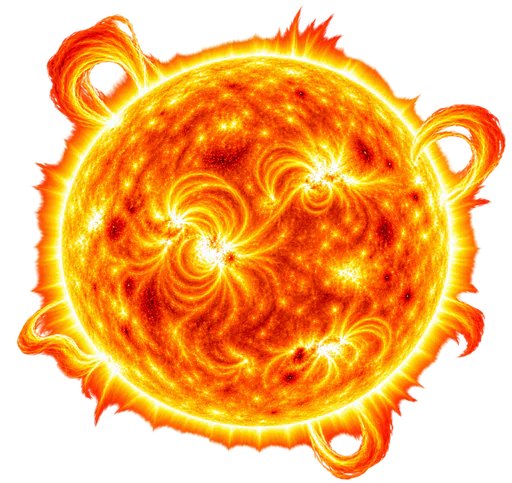
Life of a Star Simulator
Pick a stellar mass and watch in 3D how a star is born from a cold molecular cloud, lives its main sequence, and dies as a white dwarf, neutron star, or black hole.
Life of a Star Simulator Knowledge file
All stars are born in cold molecular clouds, but initial mass determines how quickly they burn, how long they live, and which compact remnant they leave.
At a glance
- Sun-like mass
- 0.8–1.4 M☉
- Massive stars
- 8–25 M☉
- Very massive stars
- 25+ M☉
- Main energy source
- Nuclear fusion
Core concepts
Main-sequence stars are in dynamic balance
Inward gravity opposes outward pressure from fusion, keeping a star stable through the longest stage of its life.
Heavier stars live shorter lives
Massive stars have more fuel but consume it far faster, so their main-sequence lives are usually shorter.
Stars make and spread elements
Fusion and supernovae create many heavier elements, returning them to space as material for new stars, planets, and life.
Ways to understand
- Low to medium massRed giant → white dwarf
The outer layers form a planetary nebula, leaving a hot core supported by electron degeneracy pressure.
- High massSupernova → neutron star
Core collapse triggers an explosion, and the remnant may be supported by neutron degeneracy pressure.
- Very high massSupernova → black hole
If the remaining core is too heavy, no known pressure can stop further collapse and a black hole forms.
What to observe
- ObserveSwitch the initial mass
Compare how the three evolutionary paths diverge after the main-sequence stage.
- ObserveNotice temperature and color
Cooler stellar surfaces appear redder; hotter ones tend toward white or blue-white.
- ClarifyLarge volume does not mean large mass
A red giant's outer layers are enormously expanded and very diffuse, so size alone does not indicate mass.