
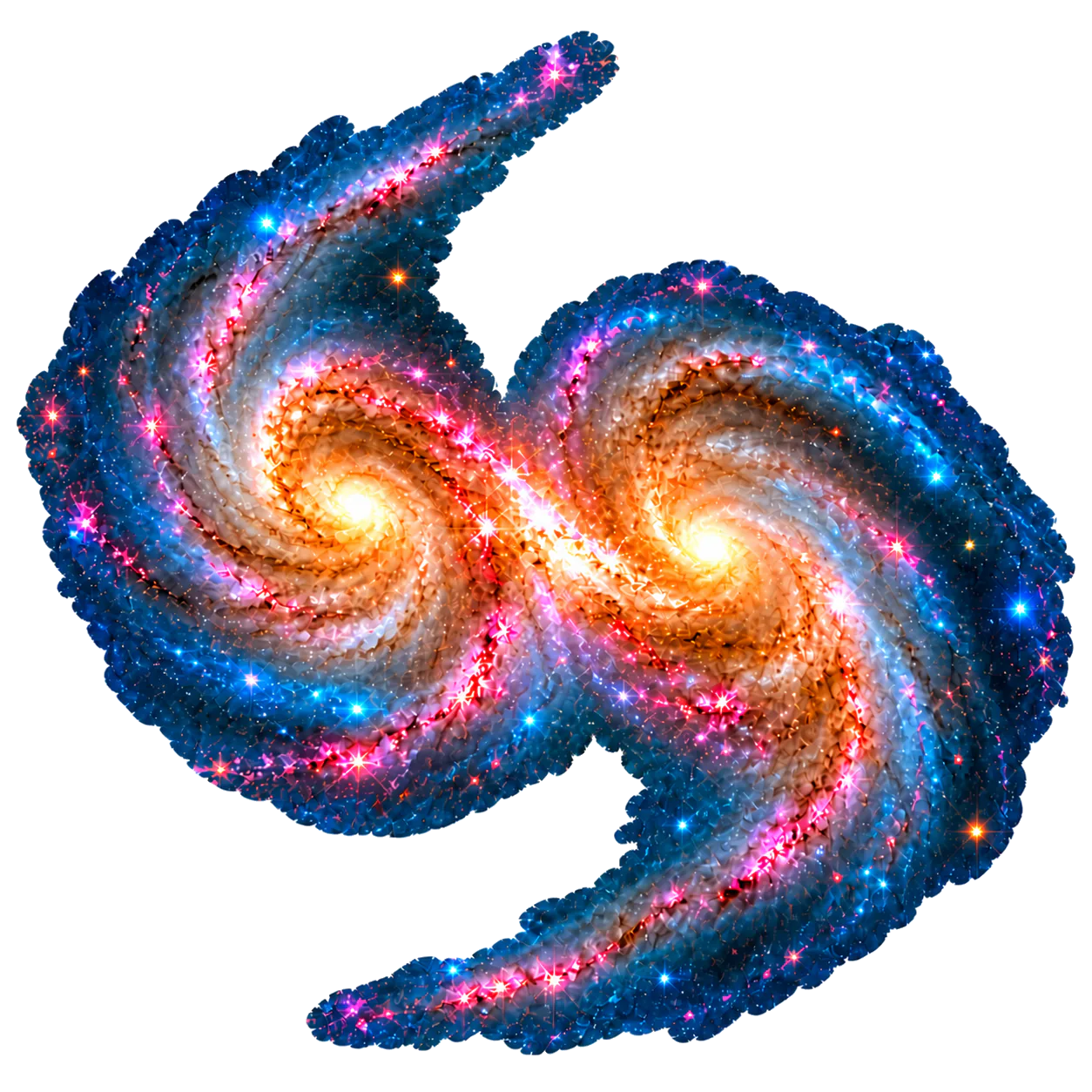
Galaxy Collision Simulator
Preview the Milky Way–Andromeda collision in seven 3D stages: tidal tails, a star bridge, repeated passes, and the final merger into the elliptical galaxy Milkomeda.
Galaxy Collision Simulator Knowledge file
In about four billion years, the Milky Way and Andromeda may pass close to each other several times and finally merge into a larger galaxy.
At a glance
- Expected start
- About 4 billion years from now
- Participants
- Milky Way × Andromeda
- Stages
- 7
- Possible result
- A large merged galaxy
Core concepts
Tidal forces draw out long tails
Differences in the galaxies' gravity distort stellar discs and create tidal tails, bridges, and shell structures.
Stars rarely hit one another
Galaxies are extremely empty; even as two galaxies pass through each other, direct collisions between individual stars remain very unlikely.
Gas clouds compress and form stars
Interstellar gas can collide, shock, and trigger intense star formation—unlike the nearly collisionless passage of stars.
Ways to understand
- First approachTidal disturbance
As the galaxies approach, outer stars and gas are pulled into long tails and bridges.
- PassageRepeated encounters
The galaxies may pass through and separate again, then lose more orbital energy through dynamical friction.
- MergerThe structure settles again
Stellar orbits are redistributed, and the two central black holes may eventually form a binary and merge.
What to observe
- ObserveTrack the tidal tails
They mark the directions of strongest gravitational disturbance and show how angular momentum is redistributed.
- ObserveSeparate stars from gas
Stars in the particle model are nearly collisionless, while real gas interacts and produces shocks.
- ConsiderThe future path is uncertain
Measurement errors and orbital models affect predictions of a direct collision, its timing, and the final shape.