
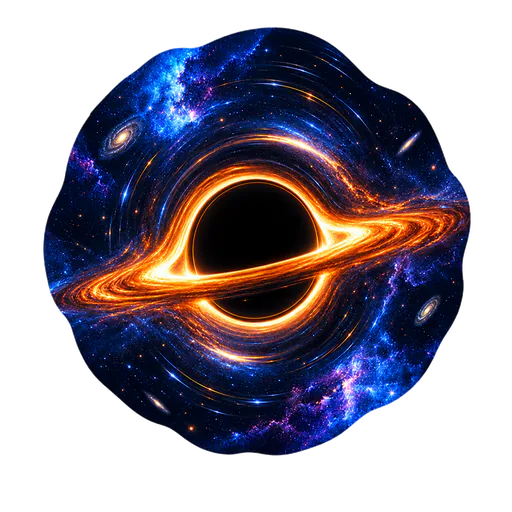
Black Hole
Explore an immersive 3D black hole, its event horizon, photon ring, gravitational lensing, and rotating accretion disc.
Black Hole Knowledge file
A black hole is not an empty hole in space, but a compact object whose gravity is so strong that even light cannot escape from within its event horizon.
At a glance
- Defining feature
- Event horizon
- Directly visible
- No
- Common origin
- Stellar-core collapse
- How we detect it
- Nearby matter and gravity
Core concepts
The event horizon is not a surface
It is a causal boundary. Once crossed, no signal can return to the outside universe.
Gravity bends spacetime
Light paths curve strongly near a black hole, distorting background images, the accretion disc, and the photon ring.
The brightness comes from nearby matter
Before falling in, gas rubs together and heats to extreme temperatures, releasing intense X-rays and other radiation.
Ways to understand
- MassStellar-mass black holes
Usually formed when massive stars die, they have masses from several to tens of Suns.
- MassSupermassive black holes
Found at the centers of most large galaxies, they can contain millions to billions of solar masses.
- ScaleSchwarzschild radius
For a non-rotating black hole, event-horizon size is proportional to mass: more mass means a larger boundary.
What to observe
- ObserveFind the photon ring
The thin bright structure near the edge comes from light bent so strongly that it may circle the black hole several times.
- ObserveChange the mass
Compare how the event horizon, apparent accretion-disc size, and lensing change with mass.
- ClarifyIts pull is not infinite
At the same mass and distance, a black hole's gravity is no different from that of any other object.